
From Netflix to Local Studios: How I Started Exploring the Global AVT Industry
When people ask me what kind of translation I enjoy the most, my answer is always the same: Audiovisual Translation.
I've been working as a translator for more than twelve years, and during that time I've explored many different areas of localization. Yet AVT has always been the one I return to. I genuinely enjoy watching films and TV series in their original language, adapting subtitles, working on dubbing scripts, thinking about lip-sync, and seeing how a translated script eventually becomes part of a finished production. If I could spend my entire career working only in AVT, I honestly would.
5-6 years ago, I decided to move away from my local market and start looking for international clients. Like most translators entering a new specialization, I had one simple question: where do all these projects actually come from?
At the time, I knew almost nothing about the global AVT industry. I assumed there were a handful of large companies working with Netflix and other streaming platforms, and that was probably where most freelance translators found work.
I couldn't have been more wrong.
Like Many Translators, I Started with Netflix
Back then, Netflix still had its well-known Hermes certification program for translators. I remember reading about it, getting excited by the opportunity, and planning to take the test. Unfortunately, by the time I seriously started researching the industry, the program had already been discontinued.
Instead of giving up, I decided to explore Netflix's localization ecosystem. Very quickly, I came across two resources that almost everyone working in AVT eventually discovers:
At that point, I genuinely believed these companies represented the entire international AVT market. After all, they were responsible for localizing content for one of the world's largest streaming platforms, so it seemed perfectly logical to assume that this was where every audiovisual translator should be looking for work.
Looking back now, it's funny how small I thought the industry was.
The Question That Changed Everything
One day, a very simple thought crossed my mind. I had already worked with Russian dubbing studios before. Some specialized in dubbing, others focused on voice-over or subtitles, and many worked almost exclusively for Russian-speaking audiences. If those companies existed here, why wouldn't Italy have its own dubbing studios? Or Spain? Germany? Brazil? Japan? Surely Netflix couldn't represent the entire global AVT industry.
That single question completely changed the way I approached my research.
Instead of looking only for Netflix vendors, I started searching country by country. My browser history quickly filled with searches like dubbing studios Italy, subtitling companies Spain, voice-over studios Germany, audiovisual localization Brazil, and dozens of similar queries. The deeper I searched, the more fascinating the industry became. Every country had its own ecosystem.
Some companies worked almost exclusively with local broadcasters, while others specialized in cinema, documentaries, streaming platforms, accessibility services, or multilingual localization. Some translated into dozens of languages, while others focused almost entirely on their domestic market.
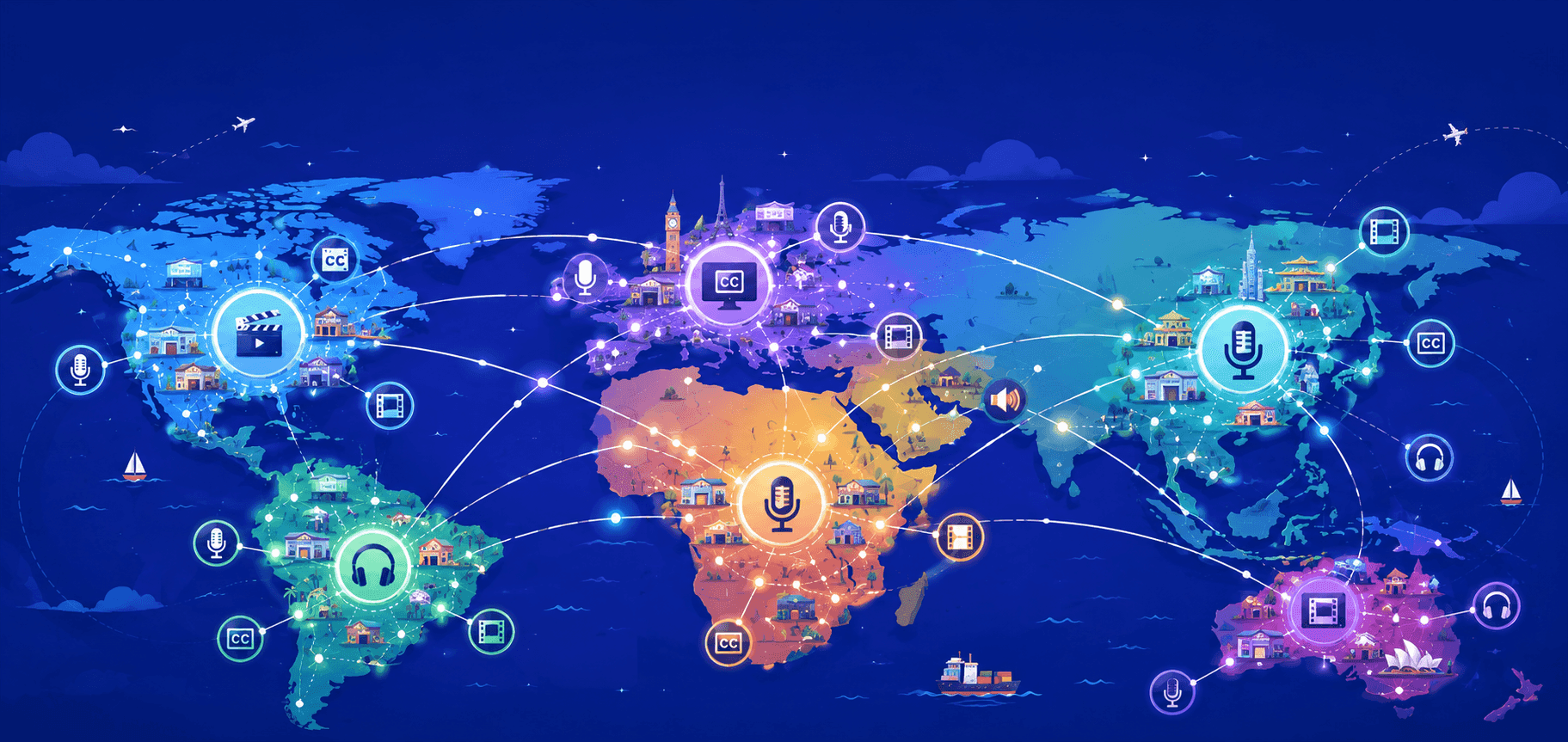
That was probably the biggest realization of my entire research journey: there isn't one AVT industry. There are hundreds of local AVT markets connected together.
The Logos I Kept Seeing Everywhere
As I continued exploring company websites, I started noticing the same logos appearing over and over again. At first, I ignored them, assuming they were simply badges that companies displayed for marketing purposes. Eventually curiosity got the better of me, and I started researching what they actually meant. One of the certifications I encountered most often was Trusted Partner Network (TPN). Unlike Netflix's own partner programs, TPN is an industry-wide security initiative supported by major entertainment companies. Studios that work with high-profile clients often pursue TPN certification because it demonstrates that they meet strict security standards for handling confidential pre-release content. It's worth mentioning, however, that a company not having TPN certification doesn't automatically make it a bad company. Many excellent studios simply focus on regional markets and have no reason to pursue it. Others are still growing, while some work exclusively with local broadcasters instead of international streaming platforms. I learned very quickly that certifications are useful signals, but they should never be the only factor when evaluating a company.
Netflix Turned Out to Be Much Bigger Than I Expected
As my research continued, I discovered that Netflix's ecosystem extended far beyond the PFP and DTT lists. For example, Netflix also maintains its Preferred Partner Program (NP3), which includes several different categories of approved vendors. Depending on their specialization, companies may appear as localization partners, audio description providers, or post-production vendors, and many studios participate in more than one Netflix program at the same time.
Once I understood this, I stopped thinking about Netflix as a single list of companies. Instead, I started seeing it as an ecosystem made up of different types of partners serving different production needs.
That realization led to another obvious conclusion. Netflix wasn't unique. Amazon works with its own trusted localization vendors. Apple collaborates with localization partners. Paramount has preferred suppliers. Broadcasters, production companies, streaming services, and media groups around the world all maintain their own networks of localization providers. The deeper I dug, the more obvious it became that the AVT industry isn't centered around one company or even one platform.
It's a global network made up of hundreds of interconnected ecosystems spread across different countries, languages, and markets.
And that was the point where my research really began.
Looking for Directories Instead of Companies
Once I realized that every country had its own AVT ecosystem, I stopped searching only for individual companies and started looking for directories instead. Surely I couldn't be the first person trying to map this industry, and I was right. Over the following months, I discovered dozens of different resources. Some were maintained by localization companies themselves, others by professional associations, community projects, or simply passionate people who had spent years collecting information about dubbing and subtitling studios around the world. Some focused on a single country, while others covered companies from dozens of regions.
Some of the resources I found particularly useful include:
- Entertainment Globalization Association (EGA)
- Trusted Partner Network (TPN)
- Regional dubbing studio directories
- Country-specific localization associations
- Fandom-maintained dubbing studio lists
- Public business directories
- Articles written by AVT companies introducing other studios
- Commercial localization databases
Each of these resources revealed another piece of the puzzle. Some introduced me to companies I had never heard of before, while others helped confirm information I had already collected. When the same company appeared in several independent sources, it became much easier to trust that it was active and well established.
At the same time, I also learned how quickly these directories become outdated. Studios merge, companies close, websites disappear, vendor application pages change, services evolve, and businesses shift their focus. A directory that looked comprehensive only two or three years ago could already contain dozens of outdated entries. That was the moment I realized that collecting company names was actually the easy part. Keeping the information accurate was where the real work began.
Building My Own Database
Originally, I never planned to build a public database. Everything started as a simple spreadsheet that I created for myself so I wouldn't lose the companies I had already researched. Every time I discovered another interesting studio, I added one more row. Before long, that spreadsheet became too large to navigate comfortably, so I started organizing everything by country, services, supported languages, and eventually by many other criteria that I personally found useful when looking for work.
Over time, I added careers pages, freelance application forms, supported language pairs, AI policies, translator reviews, and dozens of other small details that translators usually spend hours researching manually. Without really noticing, I had stopped collecting a list of companies and started building a structured database.
Today, the database includes outsourcing studios from dozens of countries and continues to grow every two weeks. Every company is checked manually before being added, and for each one we try to collect as much useful information as possible, including:
- services provided (subtitling, dubbing, voice-over, accessibility, QC, audio description, etc.);
- countries and regions where the company operates;
- supported languages;
- careers pages and freelance application forms;
- whether the company publicly recruits linguists;
- publicly available information about AI usage;
- translator reviews and company reputation;
- and many other practical details.
Whenever possible, we also verify whether a company is still active. If a studio closes, stops accepting freelancers, changes its services, or significantly restructures its business, we update the database accordingly. Since the industry changes constantly, maintaining accurate information has become just as important as discovering new companies.
Start with the Free Database
Everything I've described throughout this article comes from public sources. Nothing here is secret—it simply takes time to find, compare, verify, and organize. If you enjoy doing research yourself, I genuinely encourage you to explore the industry on your own. You'll almost certainly discover studios that perfectly match your language combinations and professional interests.
However, if you'd rather spend your time preparing your CV and sending applications instead of searching for companies, we've already done much of that research for you.
Our Basic AVT Database is completely free and provides a structured introduction to the market. It includes verified companies together with the information we believe is most useful when deciding where to apply.
When the Premium Database Makes Sense
As the database continued to grow, we realized that different translators have different needs. Some actively search for new clients throughout the year, while others only need to expand their client base once or twice. That's why we decided to make the Premium Database available as a subscription rather than a one-time purchase.
Besides containing a much larger number of companies, the Premium Database also includes additional information that requires continuous manual research, such as publicly available Project Manager and HR contacts whenever we can verify them. We continue expanding and updating the database every two weeks, adding newly discovered companies, correcting outdated information, and improving existing entries.
The important thing is that you don't need to stay subscribed forever. Many translators subscribe only while they're actively looking for new clients, sending applications, or expanding their professional network. Once they've completed their outreach, they simply cancel their subscription and return whenever they need fresh information again.
Our goal has never been to sell access to a spreadsheet. Our goal has always been to save translators hundreds of hours of research.
Join the Conversation
To tell the truth, I've probably spent more time researching companies than sending my own CV. What originally started as a personal spreadsheet gradually turned into a much bigger project, and fortunately I haven't been building it alone. Members of the BrainStorm Translate community regularly share their own experiences, recommend companies, report outdated information, discuss rates, AI, relocation opportunities, recruitment processes, and many other aspects of working in localization. Every conversation helps improve the database a little more, and every shared experience makes it easier for someone else to make an informed decision.
If you'd like to become part of that community, we'd be very happy to welcome you.
Join the BrainStorm Translate Discord
I genuinely hope this article helps you better understand how the AVT industry is structured and gives you a few new ideas about where to look for your next client.
Happy searching!